

Wraparound care
What is wraparound care? A guide to the support recommended alongside weight-loss medication
If you are taking Mounjaro or Wegovy, or are seriously considering it, you may have received the medication with little accompanying support. Wraparound care describes the medical oversight, nutrition, physical activity and behavioural support that is intended to accompany the medication, so that it is used safely and the results are maintained. It is not a wellness add-on but a defined standard of care: NICE states that people prescribed weight-loss medication should receive wraparound care focusing on diet, nutrition and increasing physical activity, and within the NHS it is a required part of treatment.[1]
Wraparound care, defined
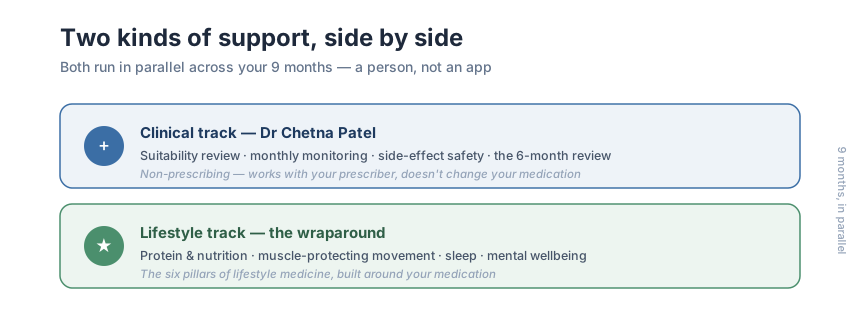
Wraparound care is the structured, ongoing support that surrounds a weight-loss medication across the whole journey: before you start, while you are taking it, and as you maintain or come off. NICE and NHS England define it as having two essential components:[1][7]
Clinical support
The medical side. A doctor or clinical service assessing whether the medication is appropriate for you, managing dose and side effects safely, monitoring your response, reviewing whether treatment should continue, and supporting you to stop safely.
Behavioural / lifestyle support
The human side. Practical, ongoing help with nutrition, physical activity, sleep and psychological wellbeing, delivered over months rather than a single appointment, so that the changes are sustained.
The principle underlying both is that nutrition influences health and body composition, not only weight, and that obesity is a chronic, relapsing condition rather than a short-term problem with a short-term remedy.
Context
Why wraparound care exists: the change that took place in 2025
For years, weight-loss medication was a niche, specialist-only option. That has changed. NICE now recommends tirzepatide (Mounjaro) for a very large group of adults, and from 2025 the NHS began rolling it out through GP surgeries.[5] With millions potentially eligible, regulators restated what has always been clinically recognised: these are powerful medications, and providing them without support does not meet the standard of good care. Wraparound care became a required treatment component. The guidance now reflects a long-standing clinical view: the injection is a tool, not a treatment plan.
Why the medication alone is not enough
The medication reduces your appetite. But appetite suppression on its own does not protect your health while you lose weight. Four things need active management, and none are done by the drug:
Muscle
When you lose weight quickly, some of what you lose is muscle rather than fat, and on these medications that share can be significant.[14] Losing muscle affects strength, metabolism and long-term health, and it is difficult to regain. Protecting it requires resistance exercise and adequate protein.
Nutrition
Eating much less makes it easy to fall short on protein, vitamins and minerals. Good wraparound care keeps smaller meals nutritionally complete.
Side effects
Nausea, constipation and reflux are common, particularly early in treatment and when the dose increases. Managed well, they are usually manageable, but they are a principal reason people abandon treatment early and unnecessarily.
Keeping it off
Up to two-thirds of the weight lost can return within a year of stopping, if nothing is put in place.[20] A plan for maintenance, or for coming off safely, is part of the treatment.
What the two components involve
Clinical support means: checking that the medication suits you and is safe alongside your other conditions; managing the dose and its increases; watching for and treating side effects; monitoring your progress; a formal review at around six months to determine whether treatment is working; and shared decisions about when and how to stop, minimising regain.
Behavioural and lifestyle support means: personalised nutrition built around higher protein and complete meals; movement that prioritises muscle retention rather than calorie-burning alone; support with sleep and psychological wellbeing; and help building habits you can sustain once the medication stops, delivered over months, because behaviour change does not happen in one session.
Official, not marketing
Is wraparound care required?
NICE quality standard QS212 (2025) makes wraparound care a marker of good care for anyone prescribed weight-loss medication.[1] It follows from NICE guideline NG246, which states that medicines are used after and alongside diet, activity and behavioural support, rather than instead of them.[7] Within the NHS, wraparound care is mandated alongside Mounjaro and delivered over a minimum of nine months, and a patient cannot be prescribed the medication on the NHS if they decline the wraparound support. QS212 also covers the period after treatment, with a specific standard for support once you stop.[1] This indicates how central this support is considered to be to safe, effective treatment.
Wraparound care across the journey
Before you start
checking suitability, taking a baseline (bloods and body composition), and establishing nutrition and movement habits before appetite falls, so that you begin with a plan.
While you are on it
managing the dose and side effects, protecting muscle, keeping nutrition complete, and monitoring how your health, not only your weight, responds.
After / maintenance
the six-month review, then either maintaining results on the lowest effective dose or coming off with a structured plan to hold the weight you have lost.
Who provides wraparound care, and where provision falls short
On the NHS, wraparound care is built in, but the NHS is funding the medication for the highest-need group first and rolling it out gradually. That leaves a substantial group of people who are clinically eligible but not yet NHS-funded and who obtain treatment privately or online instead. Levels of accompanying support vary between private and online providers, and some services supply the medication with little or no wraparound care. In those cases, people may take a powerful medication without the support the guidelines recommend. That gap is what a dedicated wraparound-care service exists to fill.
NHS vs private →How long wraparound care should last
The NHS standard is a minimum of nine months, because lasting change, muscle protection and habit-building do not happen in a few weeks. In practice, support should last as long as you are on the medication, plus the transition when you stop.
What good wraparound care looks like (use this to judge any provider)
- A named, qualified clinician, rather than only an app or a chat line
- A baseline assessment: bloods and body composition, rather than a starting weight alone
- Active muscle protection: a resistance-training and protein plan
- Genuine side-effect management, rather than a leaflet alone
- Monitoring of your health markers, not the scale alone
- A formal review point (around six months) with a genuine decision
- A maintenance and coming-off plan from the start
- Independence: advice that is not tied to selling you the medication
Common misconceptions
“It is only diet and exercise advice.”
No; it is clinical oversight together with structured behaviour change.
“I feel fine, so I do not need it.”
Its purpose is to detect what you cannot feel, such as muscle loss and nutrient deficiencies, and to protect your results.
“The medication does the work.”
It suppresses appetite. The elements that make the result healthy and lasting constitute the wraparound care.
Our programme
Wraparound care with Thrivefully
Our programme is a private version of this standard, led by a named doctor, Dr Chetna Patel, a certified Lifestyle Medicine Physician, rather than an app or a rotating team. It runs in three phases across nine months: Prepare (suitability review, baseline bloods and a plan), Support (monthly doctor check-ins plus nutrition, muscle-protection and side-effect support), and Review & Maintain (a six-month review, then holding results or coming off safely). It wraps around your medication whether it comes from the NHS or a private pharmacy; we do not prescribe, and we support you alongside whoever does.
Questions
Frequently asked questions
Sources for this page are listed on our Sources page.